
Understand your condition. Explore your care options. Take the next step with confidence.
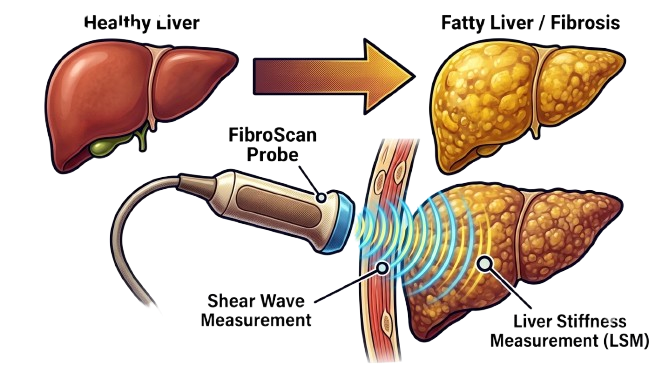
Fibroscan is a non-invasive method used to diagnose liver diseases like liver cirrhosis or scarring.
A thoughtful and personalised approach to help you understand your condition and make informed decisions.
A focused discussion about your history, symptoms and concerns.
A plan tailored to your condition, lifestyle and goals.
Continued support throughout your care journey.
From understanding your condition to planning the next steps, we work with you at every stage.
Review your history and concerns.
Discuss appropriate investigations.
Agree on your next steps together.
The liver can become stiff when repeated injury leads to scar tissue. FibroScan measures the speed of a mechanical wave travelling through the liver. The measurement helps estimate liver stiffness and the likelihood of fibrosis. CAP estimates liver fat accumulation. FibroScan does not directly examine liver tissue under a microscope and does not replace every other liver investigation.
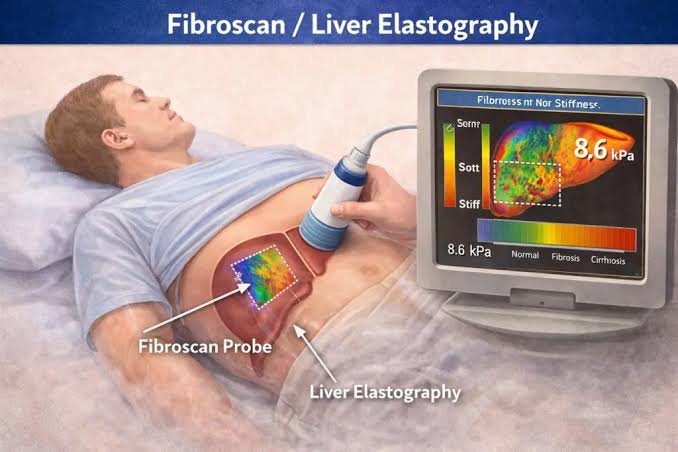
Results help estimate the likelihood and degree of liver fibrosis. Interpretation depends on the underlying disease and clinical context.
This measurement provides an estimate of liver fat accumulation.
Patients are commonly asked to fast for a specified period because eating may affect liver stiffness measurements. Confirm fasting instructions with the testing facility. Inform the operator or doctor about relevant medical conditions and follow the clinic's instructions regarding preparation and regular medicines.
Results are commonly reported as liver stiffness in kilopascals (kPa) and, when measured, a CAP value in decibels per metre (dB/m). Interpretation depends on the disease being evaluated, measurement quality, and other findings. Liver stiffness may be affected by active inflammation, bile duct obstruction, recent food intake, or fluid-related conditions. A single value should not be used independently to diagnose cirrhosis or determine treatment.
Potential benefits include non-invasive assessment without a biopsy needle, quick measurement in an outpatient setting, information about liver stiffness and estimated liver fat, and support for risk assessment in selected patients. Limitations include unreliable measurements in some cases, technical difficulties, and inability to identify every cause or microscopic feature of liver disease.
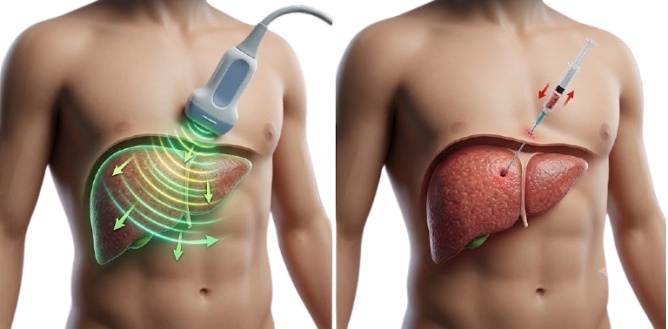
FibroScan estimates liver stiffness non-invasively. A liver biopsy involves collecting a small tissue sample for examination under a microscope. A biopsy may be considered when diagnosis remains uncertain or more detailed tissue information is required.
Living with cirrhosis can feel overwhelming. We provide clear information, practical guidance and ongoing support to help you move forward with confidence.
Information and advice tailored to your individual needs.
Understand your condition and the available options in simple terms.
We’re here for you—before, during and after your consultation.
A little preparation can help you get the most from your consultation.
Bring any relevant test results, scans or hospital letters.
A list of the medicines you are currently taking.
Write down any questions or concerns you would like to discuss.
Find quick answers to common questions about FibroScan of the liver. For anything else, we’re here to help.
It is generally painless. Patients may feel light pressure or a small vibration from the probe.
The measurement itself often takes only a few minutes, although the total appointment may be longer.
Its CAP measurement can estimate liver fat. Other investigations may also be used depending on the clinical question.
It can provide evidence supporting assessment of advanced fibrosis, but results must be interpreted alongside clinical findings and other tests.
No. The need depends on risk factors, blood tests, imaging findings, and the clinician’s assessment.
Yes. It may be repeated when clinically appropriate to monitor selected liver conditions.
Contact the clinic to discuss liver stiffness assessment and confirm the availability of FibroScan testing.
Choose your preferred location and our team will confirm your appointment.
Choose your preferred date and time. The clinic team will contact you to confirm.